
The Difference Between Granular and Liquid Fertilizer
Most gardeners already know the obvious part.
Granular fertilizer is dry. Liquid fertilizer is liquid.
There. We have conquered the first grade portion of the lesson.
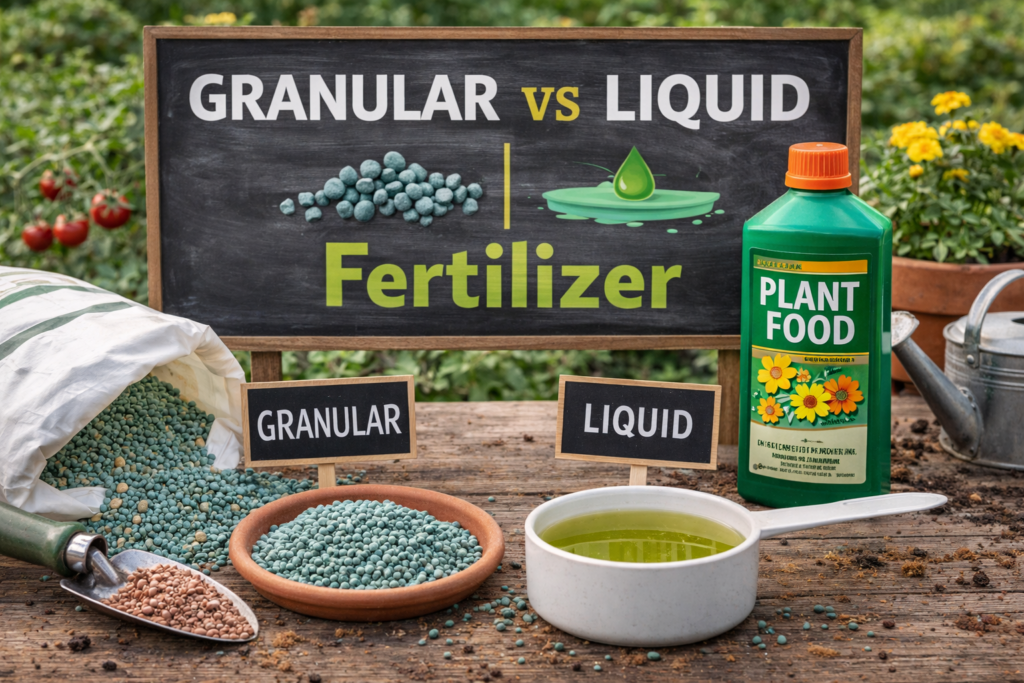
But the real difference is not just what form it comes in. The real differences are in how it works, how fast it acts, how long it lasts, how it is applied, and what kind of gardening situation it fits best.
That is where this starts to matter.
Because if you understand the difference between granular and liquid fertilizer, you can choose the one that actually makes sense for what you are growing instead of just grabbing whatever is closest at hand.
They Feed Differently
The biggest practical difference is how nutrients get delivered to the plant.
Granular fertilizer is usually applied to the soil. Once it is watered in and starts breaking down, the nutrients become available over time. Some granular products release fairly quickly, while others are designed to release more slowly.
Liquid fertilizer is already dissolved or mixed into water, so it gets to the plant faster. It can be applied to the soil around the roots or, in some cases, sprayed on the leaves as a foliar feed.
So while both can feed plants, liquid fertilizer tends to act faster, and granular fertilizer usually lasts longer.
That is one of the biggest real differences.
Speed Versus Staying Power
If a plant needs help quickly, liquid fertilizer usually has the advantage.
Because the nutrients are already in a form that can be taken up more readily, liquid feeding can give plants a faster response. That can be useful when:
- plants are actively growing
- container plants are hungry
- transplants need support
- you want a quick boost during the season
Granular fertilizer is usually better for a slower, steadier feeding pattern. It often makes more sense when:
- preparing beds
- feeding crops over a longer period
- building a routine feeding plan
- reducing how often you need to apply fertilizer
So one is not necessarily better than the other. They just behave differently.
Liquid is more of a quick delivery system.
Granular is more of a slower, longer feed.
Precision Is Different Too
Liquid fertilizer usually gives you more immediate control.
You can dilute it, adjust how strong you make it, and apply it more exactly to certain plants or containers. That can be handy when you want to feed:
- seedlings
- houseplants
- hanging baskets
- grow bags
- one specific crop that needs attention
Granular fertilizer is a little less precise once it is spread, especially in larger beds. You still measure it, of course, but it is more of a broad-area application in many cases.
That makes granular useful for feeding garden rows, beds, and larger planting areas, while liquid often shines in smaller or more targeted applications.
Risk Works a Little Differently
Both kinds of fertilizer can be overdone, but they tend to cause problems in slightly different ways.
Liquid fertilizer can be easy to apply too strongly if you are not careful with mixing. If you make it too hot, plants can be damaged fairly quickly.
Granular fertilizer can also burn plants, especially if too much is applied in one place or if it sits against stems or roots without being watered properly.
The difference is often in how fast the mistake shows up.
A liquid mistake can hit fast.
A granular mistake may build more slowly, or show up where too much product was concentrated.
Either way, more is not better. Better is better.
Soil Feeding Versus Quick Feeding
Granular fertilizer is often better suited to the kind of feeding that supports a bed over time. It sits in the soil environment and releases nutrients as watering and breakdown happen.
Liquid fertilizer feels more like a quick meal.
That is not a scientific definition. That is just the easiest way to picture it.
Granular is often part of a steadier soil-feeding routine.
Liquid is often part of a quicker response routine.
For a lot of gardeners, that means:
- granular for the main feeding plan
- liquid for the occasional boost
Convenience Depends on the Gardener
Some people love liquid fertilizer because it feels fast and simple. Mix, water, done.
Other people hate fooling with mixing, measuring, and applying it often.
Some people like granular because it is easy to spread and lasts longer.
Other people hate hauling bags around and trying to calculate how much to scatter where.
So convenience depends a lot on how you garden.
If you are feeding a whole vegetable garden, granular may feel easier.
If you are feeding containers on a porch, liquid may feel easier.
Which One Works Best in Containers?
Liquid fertilizer often has the advantage in containers because container plants use up nutrients faster and need more regular feeding.
Water moves through containers quickly. Nutrients get used up and washed through more quickly too. A liquid fertilizer can help you respond faster and feed more regularly.
Granular fertilizer can still be used in containers, especially slow-release types, but liquid feeding is often easier to adjust when the plants are growing hard and using resources fast.
Which One Works Best in Garden Beds?
Granular fertilizer often makes more sense in in-ground beds and larger growing spaces.
It can be worked into the soil, applied around plants, or used as part of a regular seasonal feeding plan. Because it tends to last longer, it often fits large-scale feeding better.
Liquid fertilizer can still be useful in the garden, especially for transplants or midseason support, but it may not always be the most practical option for feeding broad areas over and over.
So Which One Should You Use?
That depends on what you need.
Choose granular fertilizer when:
- you want longer-lasting feeding
- you are feeding beds or larger areas
- you want fewer applications
- you are building a steady fertility plan
Choose liquid fertilizer when:
- you want quicker results
- you are feeding containers
- you want more targeted feeding
- you need a boost during active growth
- you are comfortable mixing and applying more often
A lot of gardeners use both.
And honestly, that often makes the most sense.
Final Thoughts
The real difference between granular and liquid fertilizer is not just that one is dry and one is wet. The real difference is how they feed, how quickly they act, how long they last, and where they fit best in your gardening routine.
Granular fertilizer is usually slower and longer-lasting. Liquid fertilizer is usually faster and more immediate. One is not automatically better than the other. The better choice depends on the crop, the growing space, and what the plant actually needs.
Because in gardening, the smartest answer is usually not “Which one is best?”
It is “Which one is best for this job?”