
Caring for Your Compost
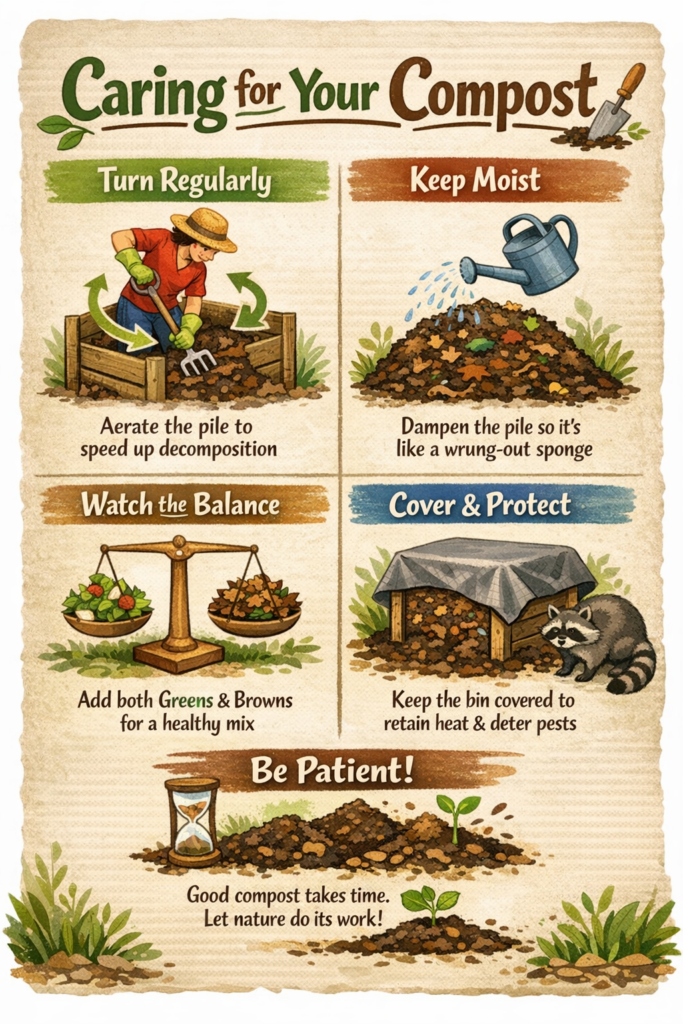
Making compost is one thing. Keeping a compost pile healthy enough to actually turn into good compost is another.
A lot of people start out strong, throw some scraps and leaves into a pile, and then just sort of hope nature will take it from there. Sometimes that works well enough. Sometimes it turns into a soggy mess, a dry heap that just sits there, or a stinky little science experiment nobody wants to get near. Compost is not difficult, but it does need some care if you want it to do its job well.
The good news is that caring for your compost is not complicated once you know what the pile needs. Most of the work comes down to paying attention to a few basics: moisture, airflow, balance, and time. If you can manage those four things, you are already well ahead of a lot of people.
Keep the Moisture at the Right Level
One of the most important parts of caring for compost is moisture. A compost pile needs water because the organisms doing the work need a damp environment to stay active. If the pile gets too dry, decomposition slows way down and the whole thing can just sit there looking tired and unchanged.
At the same time, too much water creates a different problem. A soaked pile can turn heavy, airless, and smelly. Instead of breaking down in a healthy way, it may go sour and slimy. That is when people start thinking composting is disgusting, when really the pile is just too wet and poorly balanced.
The easiest rule of thumb is this: your compost should feel like a wrung-out sponge. Damp, yes. Dripping, no. If the pile is dry, add a little water while turning it. If it is too wet, add more browns and let some air get back in.
Make Sure the Pile Can Breathe
Compost needs oxygen. The tiny workers breaking down all that organic matter do best when the pile has enough airflow. If the materials get packed too tightly or too wet, the air gets squeezed out. Then the pile starts breaking down the wrong way, and that is when nasty smells and slow progress usually show up.
This is one reason turning the pile helps. Turning loosens things up, moves wetter material around, and lets fresh oxygen in. A pile that gets turned now and then usually stays healthier and breaks down more evenly than one that is left packed tight for months.
You do not have to obsessively turn it every other day unless you are trying to run a fast hot pile. But you do want to make sure the pile is not matted down into a solid block of misery. If it smells rotten, looks slimy, or seems stuck, lack of airflow is often part of the problem.
Keep a Good Balance of Greens and Browns
A happy compost pile usually needs both nitrogen-rich materials and carbon-rich materials. In everyday compost language, that means greens and browns. Greens include things like kitchen scraps, coffee grounds, fresh grass clippings, and fresh garden trimmings. Browns include things like dry leaves, straw, shredded paper, and cardboard.
When the pile has too many greens, it often gets wet, heavy, and smelly. When it has too many browns, it can stay dry and slow and seem like it is doing absolutely nothing. Neither extreme is what you want.
The pile does not need a perfect mathematical formula every time you add to it, but it does need some common sense. If you have been dumping in kitchen scraps all week, it probably needs more dry material. If it looks like nothing but old leaves and cardboard, it may need a little more nitrogen-rich material to wake it up.
Watch the Size of the Materials
Big materials break down more slowly. That is not a tragedy, but it does affect how quickly your compost finishes. Thick stems, large leaves, whole branches, and big chunks of kitchen scraps take longer than smaller pieces.
If you want the pile to work better, it helps to break things down a bit before adding them. Shred cardboard. Chop big stalks. Run over leaves with a mower if you want to speed things up. You do not have to reduce everything to dust, but smaller pieces usually compost faster and more evenly.
This is one of those quiet little tricks that makes a real difference without being hard to do.
Pay Attention to the Smell
A healthy compost pile usually smells earthy. It should smell like damp soil, forest floor, or rich organic matter. It should not smell rotten, sour, or like something is actively dying in there.
Smell is one of the easiest ways to tell how your compost is doing. If it smells bad, the pile is trying to tell you something. Usually it means one of three things: it is too wet, too packed, or has too much nitrogen-rich material and not enough browns.
That is useful information. Instead of getting disgusted and abandoning the pile, treat the smell like a clue. Add dry browns, turn the pile, and check the moisture. In a lot of cases, that alone will start correcting the problem.
Protect the Pile from Extremes
Compost can handle a lot, but it still does better when it is not constantly fighting extreme conditions. A pile baking in fierce sun may dry out faster than you want. A pile sitting in a low wet area may stay too soggy. A pile left uncovered in endless rain can become waterlogged, while one neglected during a drought may go nearly dormant.
This does not mean you need to build the pile a tiny climate-controlled house. It just means you should pay attention to how weather affects it. In hot dry conditions, you may need to add water occasionally. In heavy rain, you may need more browns or some kind of cover to keep the pile from becoming soup.
Good compost care is often just good observation. Look at what the weather is doing and adjust accordingly.
Know When to Leave It Alone
Not every compost problem requires you to charge out there with a pitchfork and a heroic look on your face. Sometimes the pile just needs time.
People can fuss a compost pile to death by constantly rearranging it, overwatering it, or trying to “fix” what is actually a normal stage of breaking down. If the pile smells fine, looks reasonably balanced, and is slowly changing, it may simply be doing what compost does.
Caring for compost is not only about action. Sometimes it is about restraint too. Check it, pay attention, and help when needed, but do not assume every quiet pile is a crisis.
Use the Finished Compost at the Right Time
Part of caring for your compost is knowing when it is ready and using it wisely. Finished compost is darker, crumbly, earthy, and mostly unrecognizable as the original ingredients. It should look stable, not raw, and it should not feel like it is still actively heating and collapsing in on itself.
If you use compost too early, especially around seeds or tender roots, it may still be too active and unfinished. That can cause more trouble than help. Letting compost finish and cure properly is part of good compost care too.
Once it is ready, use it where it can actually do some good. Spread it in beds, mix it into garden soil, top-dress around plants, or add it where the soil needs organic matter and improvement.
Final Thoughts
Caring for your compost is really about learning to read the pile and respond to what it needs. Keep it moist but not soaked, airy but not dried out, balanced but not overmanaged. Add the right kinds of materials, pay attention to smell and texture, and understand that good compost takes both biology and time.
Once you get the feel for it, compost care becomes a lot less intimidating. It stops being a mysterious heap in the corner and starts becoming what it ought to be: one of the most useful, practical tools in the whole garden.