
Composting Do’s and Do Not’s
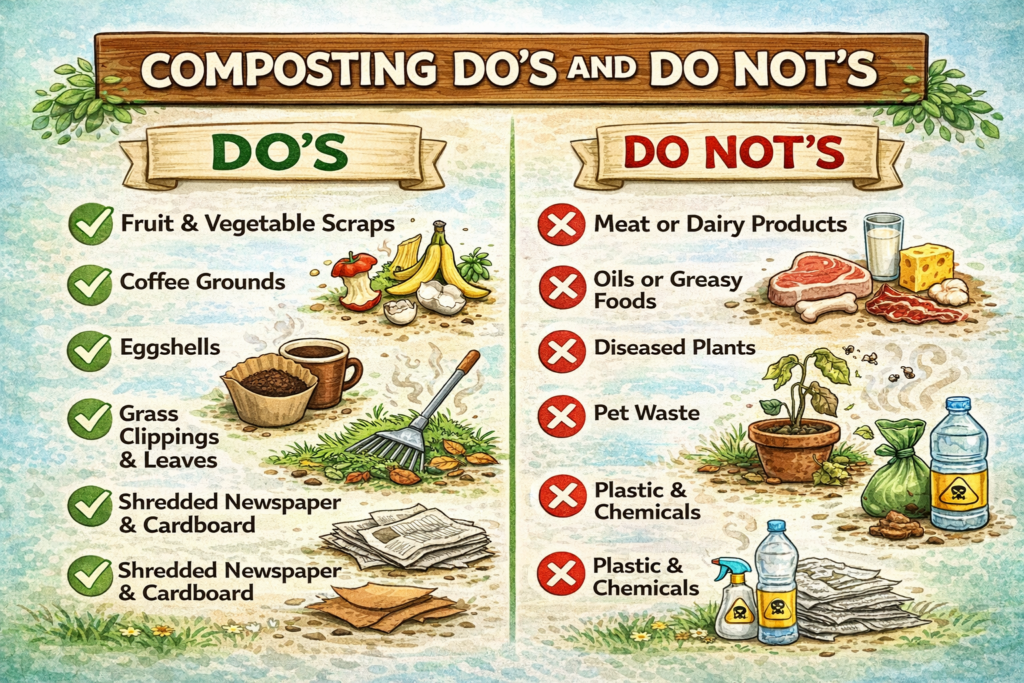
Composting is not hard, but it is one of those things people can make a lot harder than it needs to be. At its core, composting is simply the breakdown of organic matter into something useful for the garden. You are taking scraps, leaves, clippings, and other natural materials and letting time, moisture, air, and living organisms turn them into a soil-building amendment.
That does not mean anything goes. A compost pile is not a magical disappearance box where you can toss every questionable thing on the property and hope it turns into black gold. Some materials belong there, some do not, and some belong there only under the right conditions.
If you know the basic do’s and do nots, you can save yourself a whole lot of smell, mess, pests, and disappointment.
Do use a good mix of greens and browns
A healthy compost pile needs balance. Greens provide nitrogen, and browns provide carbon. If the pile is loaded with only kitchen scraps, fresh grass, and other wet materials, it may get slimy and smelly in a hurry. If it is all dry leaves, cardboard, and straw, it may just sit there and act bored for months.
A better pile includes both. Think of greens as the fuel for microbial activity and browns as the structure that keeps the pile from turning into a wet, airless blob. You do not have to measure every handful like a laboratory experiment, but you do want a reasonable mix.
Do keep the pile moist, but not soaked
A compost pile should feel damp, not dripping. The easiest way to think about it is that it should feel something like a wrung-out sponge. If it is too dry, decomposition slows down because the organisms doing the work need moisture. If it is too wet, air gets squeezed out and the pile can turn stinky, slimy, and unpleasant.
That is one reason location and weather matter. A pile baking in full summer sun may need water now and then, while a pile getting drenched in every storm may need more browns or better airflow. Moisture is important, but sogginess is trouble.
Do chop or shred materials when it makes sense
Big chunks break down more slowly than smaller ones. Whole branches, thick stems, and full-size leaves will eventually decompose, but they are going to take their sweet time about it. If you want the pile to work faster, smaller pieces help because they give more surface area to the organisms doing the breaking down.
That does not mean you need to spend your life chopping every lettuce leaf into confetti. It just means a little shredding or chopping can speed things up, especially with leaves, cardboard, and larger plant material.
Do turn the pile if you want faster compost
Turning is not absolutely required for composting to happen, but it can help a lot if you want things to move faster. Turning mixes the materials, brings in oxygen, and helps keep the pile from matting down into a dense, wet lump. It can also even out decomposition so one section is not finished while another still looks like last week’s salad.
If you are doing a more hands-off, cold-style compost pile, you may turn less often or not much at all. But if you want a hot, active pile, turning is one of the easiest ways to help it along.
Do use finished compost in the garden
Finished compost is one of the most useful materials a gardener can have. It improves soil structure, helps with moisture retention, supports soil life, and adds organic matter in a stable form. When it is done properly, compost becomes a valuable part of building healthier garden soil over time.
The key word there is finished. Good compost is usually dark, crumbly, earthy-smelling, and mostly unrecognizable as the original pile ingredients. If it still looks like half-rotted kitchen waste and smells like the devil’s stew pot, it is not ready yet.
Do compost common garden and kitchen materials
Many everyday organic materials are excellent for composting. These include things like vegetable scraps, fruit scraps, coffee grounds, tea leaves, eggshells, dry leaves, straw, grass clippings, and plant trimmings.
Shredded cardboard and plain paper can also be useful browns in many compost systems.
The pile works best when the ingredients are varied and reasonably balanced. A mix of materials usually creates a healthier composting environment than dumping one giant mass of the same thing over and over again.
Do not add meat, grease, or oily foods to a typical backyard pile
This is where a lot of people get a little too optimistic. In a regular backyard compost pile, meat scraps, greasy leftovers, oils, dairy-heavy foods, and similar materials are usually more trouble than they are worth. They can smell bad, attract pests, and break down in unpleasant ways if the system is not built to handle them.
There are specialized composting systems that can process more challenging materials, but for the average home compost pile, it is much better to keep those out.
Do not add diseased plants unless you know your pile gets hot enough
A weak or slow pile may not kill off plant diseases. If you toss diseased tomato vines, mildew-covered squash leaves, or other problem plant material into a pile that never really heats up, you may be preserving your problems instead of solving them. Then later, when that compost goes back into the garden, the whole ugly story comes right along with it.
If you know you run a properly managed hot pile, that is one thing. If you do not, it is safer to leave badly diseased material out.
Do not add weeds gone to seed
This is another one that comes back to bite people. If you add mature weeds full of viable seed to a compost pile that does not get hot enough to kill them, you may be making future trouble with your own two hands. Then you get to spread that trouble neatly across the garden later and act surprised when it sprouts.
Young weeds without seed heads are one thing. Fully mature weeds ready to reproduce their little hearts out are another. When in doubt, keep seedy weeds out.
Do not assume manure is automatically compost
Manure can be a valuable ingredient in compost, but it is not the same thing as finished compost. Fresh or poorly aged manure can be too hot, may contain pathogens, and may carry weed seeds. It needs to be handled carefully and, in many cases, composted properly before garden use.
This is one area where sloppy language leads to sloppy practice. Calling manure “compost” does not magically make it safe, stable, or finished.
Do not let the pile go airless
A pile that is too packed, too wet, or too dense can lose oxygen and begin breaking down anaerobically. That usually means bad smells, slower decomposition, and a much less pleasant composting experience overall.
If the pile starts smelling rotten or sour instead of earthy, lack of oxygen is often part of the problem.
That is one reason structure matters. Browns, turning, and avoiding a soggy mess all help keep the pile breathing.
Do not obsess over perfection
This may be the most important do not on the whole page. Composting works best when you understand the basics, but it does not require some saintly level of precision.
You do not have to weigh every banana peel or hold a prayer meeting over the carbon-to-nitrogen ratio before adding leaves.
A compost pile is a living process, not a chemistry pageant. Good habits matter, but perfection is not required. If you keep reasonable balance, moisture, airflow, and patience in the mix, compost usually happens.
Final Thoughts
Composting is one of the simplest and most useful things a gardener can do, but it works best when you understand what helps the process and what works against it.
Good compost comes from good materials, decent balance, enough moisture, enough air, and a little time. Trouble usually comes from the same few mistakes over and over: too wet, too dry, too dense, too messy, or too many things that never should have gone in the pile in the first place.
Once you learn the basic do’s and do nots, composting gets a whole lot less intimidating. Then it starts becoming what it ought to be: a practical, steady way to turn everyday organic matter into something your garden can really use.