
Composting Terminology
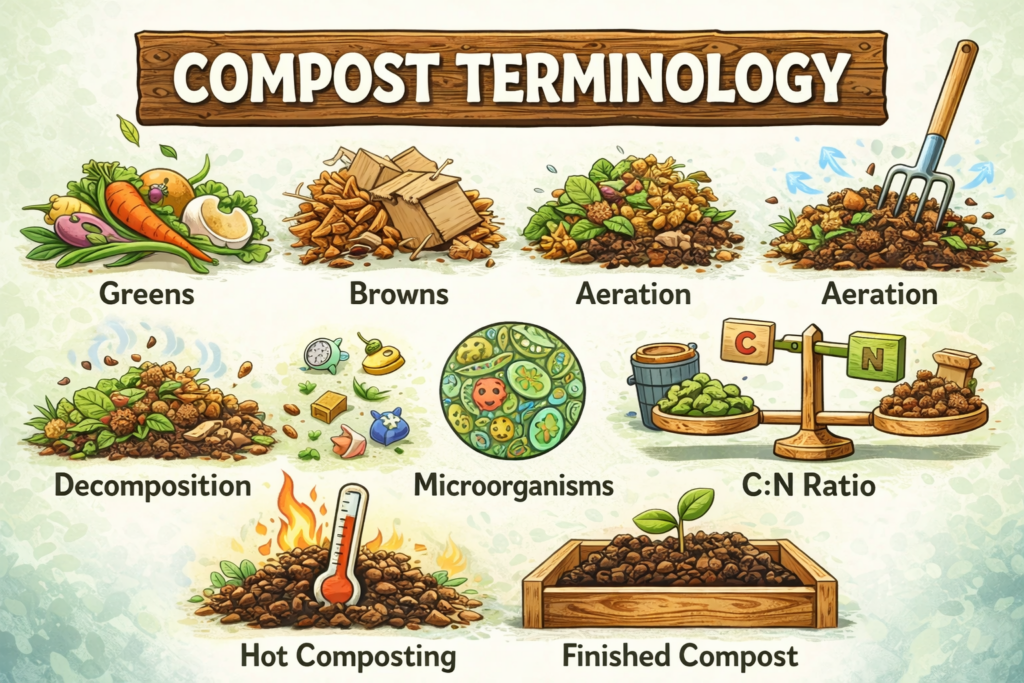
If you spend very much time reading about compost, you are going to run into a whole pile of terms that sound like everybody else already knows what they mean.
Green materials. Brown materials. Finished compost. Hot compost. Cold compost. Turning the pile. Curing. Carbon to nitrogen ratio. It can start sounding like compost has its own private language.
And honestly, it sort of does.
The good news is that most of the terminology is not nearly as complicated as it sounds. Once you understand the basic words, composting gets a whole lot less mysterious.
Compost
Compost is decomposed organic matter that has broken down into a dark, crumbly, earthy-smelling material that can be added to soil.
It is made from things like plant scraps, leaves, grass clippings, kitchen scraps, and other compostable materials. Over time, microbes and other organisms break those materials down into something that helps improve soil structure, water retention, and fertility.
In plain English, compost is old organic matter turned into good garden stuff.
Composting
Composting is the process of breaking down organic materials into compost.
That process can happen in a pile, a bin, a tumbler, a trench, or even a simple heap in a corner somewhere. What matters is that organic material is breaking down over time.
Organic Matter
Organic matter is any material that came from living things.
In composting, that usually means things like:
- leaves
- vegetable scraps
- fruit scraps
- coffee grounds
- grass clippings
- straw
- shredded paper
- plant trimmings
These are the materials that feed the compost pile and eventually become compost.
Greens
“Greens” are compost ingredients that are relatively high in nitrogen.
They are called greens even when they are not actually green in color.
Common greens include:
- fresh grass clippings
- vegetable scraps
- fruit scraps
- coffee grounds
- fresh plant trimmings
- manure from suitable sources
Greens help fuel the microbial activity that makes compost happen.
Browns
“Browns” are compost ingredients that are relatively high in carbon.
These are the drier, more fibrous materials in the pile.
Common browns include:
- dry leaves
- straw
- shredded cardboard
- shredded paper
- small twigs
- dried plant material
Browns help add structure, air space, and carbon to the pile.
Carbon-to-Nitrogen Ratio
This is often shortened to C:N ratio.
It refers to the balance between carbon-rich materials and nitrogen-rich materials in the compost pile.
You do not have to stand in the yard doing compost algebra every afternoon, but this balance matters. Too many greens can make the pile wet, stinky, and slimy. Too many browns can make it dry and slow to break down.
A good compost pile usually needs both.
Hot Composting
Hot composting means building and managing a pile in a way that heats up enough to break materials down more quickly.
A hot pile works faster because microbial activity raises the internal temperature. This can help kill some weed seeds and pathogens if the pile gets hot enough and is managed well.
Hot composting usually requires:
- enough material
- a good mix of greens and browns
- moisture
- airflow
- occasional turning
It is faster, but it takes more active management.
Cold Composting
Cold composting is a slower, more hands-off method.
You add compostable materials, let them break down over time, and do not worry as much about heating the pile up quickly.
This method is easier, but slower. It may not kill weed seeds or disease organisms as reliably as a hot pile.
Cold composting is still real composting. It just moves at a more leisurely pace.
Finished Compost
Finished compost is compost that has broken down enough to be stable and ready to use in the garden.
It is usually:
- dark
- crumbly
- earthy-smelling
- cool to the touch
- no longer recognizable as the original materials, or only barely
Finished compost should not smell rotten, sour, or like raw garbage.
Unfinished Compost
Unfinished compost is material that is still breaking down.
It may still contain obvious bits of the original ingredients, and it may still be actively heating or changing. Unfinished compost can sometimes tie up nitrogen temporarily if mixed directly into soil before it is ready.
That is why it helps to know whether your pile is truly finished or just partway there.
Compost Pile
A compost pile is simply the place where compostable materials are heaped together to decompose.
It can be a formal structure or an informal heap. Fancy is optional.
Compost Bin
A compost bin is a container or enclosed structure used to hold composting materials.
Some people use wire bins, wood bins, plastic bins, or store-bought systems. A bin helps keep things contained and tidy, but it is not required for compost to happen.
Compost Tumbler
A compost tumbler is a rotating compost container designed to make turning easier.
It can be convenient, especially for people who want a neater system or do not want to turn a pile with a fork. But like any method, it still depends on having the right materials and moisture balance.
Turning the Pile
Turning the pile means mixing or flipping the compost so air gets into it.
This can help:
- speed decomposition
- keep the pile from getting matted down
- reduce foul smells
- help the materials break down more evenly
Hot compost piles usually benefit more from turning than cold piles do.
Aeration
Aeration means getting air into the compost pile.
Composting works best when there is enough oxygen for the helpful microbes doing the breaking down. A pile that is too packed, too wet, or too dense may lose airflow and start smelling bad.
Anaerobic
Anaerobic means without oxygen.
If a compost pile becomes too wet, packed down, or airless, it may start breaking down anaerobically. That usually leads to unpleasant smells and slower, messier decomposition.
A rotten smell is often a sign something has gone a little too anaerobic.
Aerobic
Aerobic means with oxygen.
This is the kind of decomposition you usually want in a healthy compost pile. Aerobic composting tends to smell better and work more efficiently.
Moisture Content
A compost pile should be moist, but not soaked.
A good rule of thumb is that it should feel roughly like a wrung-out sponge. Too dry, and decomposition slows down. Too wet, and the pile may go slimy, stinky, and airless.
Leachate
Leachate is the liquid that can drain out of a compost pile or bin, especially if the pile is too wet.
People sometimes call any compost liquid “compost tea,” but that is not always correct. Random liquid draining from a soggy pile is not the same thing as a deliberately made compost extract.
Leachate can smell unpleasant and may need to be handled carefully.
Compost Tea
Compost tea is a liquid made by steeping compost in water.
Gardeners use the term in different ways, but generally it refers to a compost-based liquid used around plants or soil. It is not the same thing as dirty runoff from an overloaded compost bin.
Curing
Curing is the stage after the most active composting is done, when the compost is allowed to rest and stabilize further.
This helps ensure the compost is mature and less likely to harm plants or behave unpredictably in the garden.
Think of it as the pile settling down and finishing the job.
Mature Compost
Mature compost is compost that is finished, stable, and ready to use.
It is safe for plants and no longer in a highly active stage of decomposition.
Immature Compost
Immature compost is still actively breaking down and is not fully ready for use, especially around seedlings or delicate plants.
It may still heat up, smell off, or contain recognizable materials.
Feedstock
Feedstock is just a more technical word for the raw materials going into the compost pile.
Leaves, scraps, straw, clippings, cardboard, and similar items are all feedstocks.
Particle Size
Particle size refers to how large or small the compost ingredients are.
Smaller pieces usually break down faster because they have more exposed surface area. That is why shredded leaves compost faster than whole ones, and chopped scraps break down faster than big chunks.
Worm Composting
Worm composting, also called vermicomposting, uses worms to help break down food scraps and other organic materials.
The finished material is often called worm castings, and it is valued as a rich soil amendment.
Worm Castings
Worm castings are the digested material produced by composting worms.
They are often used to enrich potting mixes, seed-starting blends, and garden soil.
Browns-to-Greens Balance
This is the practical, everyday version of the carbon-to-nitrogen ratio.
Too many greens can make a pile soggy and smelly. Too many browns can make it dry and slow. A balance between the two helps the pile work the way it should.
Finished Versus Ready-to-Use
Just because a compost pile looks pretty good does not always mean it is fully ready.
If it still heats back up after turning, still smells strong, or still shows lots of recognizable ingredients, it may need more time. Compost is ready when it is stable, earthy, and mostly broken down.
Final Thoughts
Compost terminology can sound more intimidating than it really is, but once you know the basic language, the whole process makes a lot more sense.
At its core, composting is just the breakdown of organic matter into something useful for the garden. The terms mostly describe the materials, the conditions in the pile, and the stages of decomposition.
And once you understand the words, you can spend a whole lot less time feeling confused and a whole lot more time building better soil.