
Make Your Own Fertilizers
There is something deeply satisfying about making your own fertilizer.
Part of it is the thrift of it. Part of it is the self-sufficiency. And part of it is just plain common sense. If you already have materials on hand that can help feed your plants, it makes good sense to know how to use them.
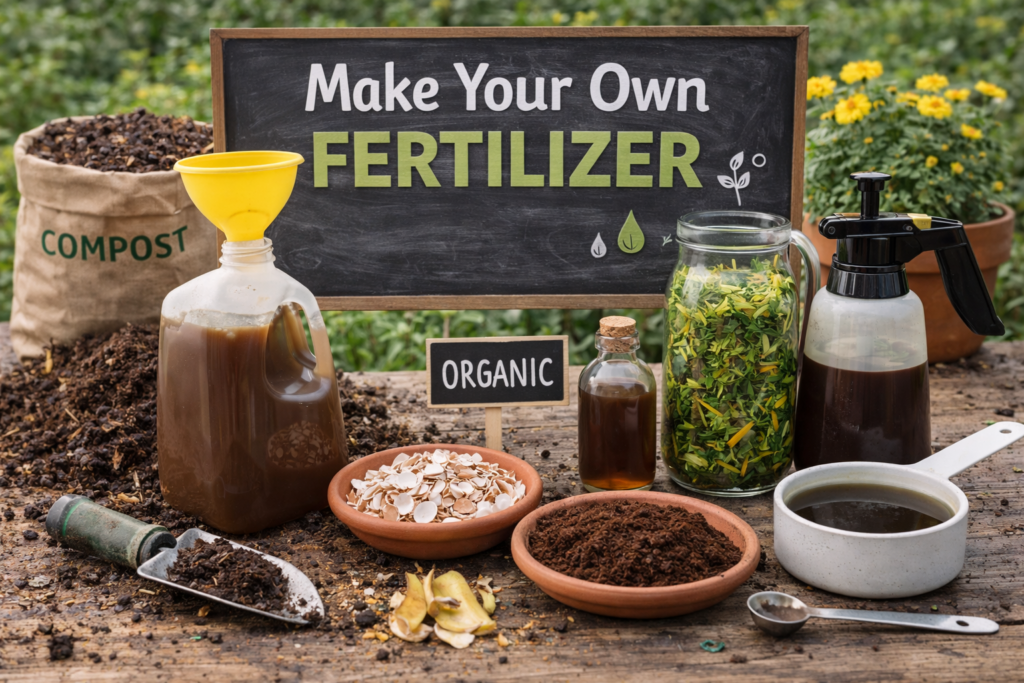
Now, before we get too far into this, homemade fertilizer needs a little honesty.
It is useful. It can be effective. It can absolutely be part of a healthy garden routine.
But homemade fertilizer is usually less precise than a bagged commercial product. You are not getting a guaranteed analysis stamped neatly on the side. You are working with natural materials that vary. That does not make them bad. It just means you use them thoughtfully, not blindly.
And just like with store-bought fertilizer, the goal is not to throw every possible thing at the garden and hope something sticks. The goal is to feed plants in a sensible way.
Homemade Fertilizer Is Not the Same as Compost
This is worth clearing up before we get into recipes.
Compost improves the soil and adds some nutrients over time. Fertilizer is meant more directly to feed the plant.
The line can get blurry because some homemade materials do both to a degree, but for this page, we are focusing on materials and mixtures used primarily as fertilizers, whether solid or liquid.
Solid Homemade Fertilizers
Solid fertilizers are usually applied to the soil surface, scratched in lightly, side-dressed around plants, or added to planting holes in small amounts.
They tend to work more slowly than liquid fertilizers, but they also tend to last longer.
1. Simple Compost-and-Castings Garden Feed
This is a gentle, all-purpose homemade fertilizer for garden beds and containers.
Mix:
- 2 parts finished compost
- 1 part worm castings
- 1 part fine, dry leaf mold or screened aged manure
Use it as a top-dressing around vegetables, herbs, and flowers.
This is not a “hot” fertilizer. It is a milder feed that helps nourish plants while also supporting the soil around them.
2. Bone Meal and Compost Root Blend
This blend is useful for crops where root development, flowering, and fruiting matter.
Mix:
- 2 parts finished compost
- 1 part bone meal
- 1 part worm castings
Use lightly around tomatoes, peppers, flowering plants, and transplants.
Because bone meal breaks down gradually, this is more of a steady-support fertilizer than a quick fix.
3. Banana Peel and Eggshell Dry Mix
This is a simple homemade fertilizer idea for gardeners who want to use kitchen scraps in a more targeted way.
Mix:
- dried banana peels, crushed into small flakes or powder
- dried eggshells, ground finely
- a small amount of finished compost to blend it
A workable ratio is:
- 2 parts dried banana peel
- 1 part finely ground eggshell
- 2 parts compost
The banana peel contributes potassium. The eggshell adds calcium, though it breaks down slowly. The compost helps make the blend easier to apply and more balanced.
Use this lightly around fruiting crops and flowering plants. Do not expect instant miracles from it. It is a slower, supplemental feed.
4. Kelp and Compost Dry Blend
If you have access to dried kelp meal or seaweed meal, it makes a useful addition to a homemade dry fertilizer.
Mix:
- 3 parts compost
- 1 part kelp meal
- 1 part worm castings
This works well as a light top-dress around many crops. Kelp is often valued more for micronutrients and plant vigor support than for being a heavy NPK punch.
5. General Garden Side-Dress Mix
This is a broader homemade dry fertilizer blend for established plants in the garden.
Mix:
- 2 parts finished compost
- 1 part aged manure
- 1 part worm castings
- 1/2 part bone meal
- 1/2 part kelp meal
Use it as a side-dressing around heavy feeders, but do not pile it against stems.
This is a richer blend, so a little goes farther than you might think.
Liquid Homemade Fertilizers
Liquid fertilizers act faster because the nutrients are already moving through water. That makes them especially useful for containers, fast-growing plants, and situations where you want a quicker response.
But liquid fertilizers also need more care. If you make them too strong, you can do more harm than good.
1. Compost Tea
Compost tea is probably the best-known homemade liquid fertilizer.
To make a simple version:
- fill a bucket about 1/3 full with finished compost
- add water to fill the rest
- let it steep for a day or two
- stir once or twice
- strain before using if needed
Dilute if it looks especially dark or strong.
This makes a mild liquid feed that can be used around many plants. It is best used fresh rather than stored for long periods.
2. Worm Casting Tea
Worm castings make an excellent base for a gentle liquid fertilizer.
To make it:
- place 1 to 2 cups of worm castings in a bucket
- add about 1 gallon of water
- let it steep overnight or up to 24 hours
- stir occasionally
- strain if desired
This creates a mild, plant-friendly liquid feed that works especially well for seedlings, houseplants, herbs, and container plants.
3. Seaweed Tea
If you have clean seaweed or a dried kelp product, it can be used to make a liquid feed.
To make it:
- soak chopped seaweed or kelp meal in water
- let it steep for a couple of days
- strain and dilute before use
Seaweed-based liquids are often used more as a tonic than as a high-powered fertilizer. They are valued for trace minerals and general plant support.
4. Banana Peel Tea
This is a simple homemade liquid often used for flowering and fruiting plants.
To make it:
- place chopped banana peels in a jar or bucket
- cover with water
- let steep for 24 to 48 hours
- strain and use the liquid to water plants
This is a mild supplemental feed, not a complete fertilizer. It is best thought of as part of the toolbox, not the whole toolbox.
5. Manure Tea
This is an old-fashioned garden fertilizer, but it deserves a caution label in bold letters.
Use only aged or well-composted manure, never fresh.
To make it:
- place aged manure in a porous sack or old cloth bag
- suspend it in a bucket or trash can of water
- let it steep
- dilute well before using
This can be a stronger liquid feed, so it should be used carefully and never as some kind of daily plant beverage.
Also, common sense applies here in a big way. Be thoughtful, sanitary, and cautious, especially around edible crops.
Which Homemade Fertilizer Is Best?
That depends on what you need.
Use solid homemade fertilizers when:
- you want slower feeding
- you want to side-dress plants
- you are feeding beds rather than just containers
- you want the feeding to last longer
Use liquid homemade fertilizers when:
- you want a quicker boost
- you are feeding containers
- plants need more immediate support
- you want more targeted application
For many gardens, the smartest approach is using both:
- a solid fertilizer for steady feeding
- a liquid fertilizer for the occasional boost
A Few Common-Sense Warnings
Homemade fertilizer is useful, but more is not better.
Too much can:
- burn roots
- create nutrient imbalances
- encourage weak, overly lush growth
- cause problems instead of solving them
A few other reminders:
- use only finished compost
- use only aged or composted manure
- avoid diseased plant material
- do not assume every homemade fertilizer is safe for every crop in every amount
- test things gently before going wild with them
And if a plant problem is really caused by bad drainage, poor sunlight, wrong pH, or disease, fertilizer may not solve it at all.
Final Thoughts
Making your own fertilizers can be a smart, practical way to feed your garden using materials you already have on hand.
Solid homemade fertilizers are useful for slower, steadier feeding. Liquid homemade fertilizers are useful when you want a quicker response. Neither one has to be fancy to be effective. What matters most is understanding what the material is likely to do, applying it reasonably, and remembering that feeding the plant is only one part of good gardening.
Because a healthy garden is built with good soil, good sense, and sometimes a bucket of something homemade.