Soil Types
If you are serious about wanting to grow a garden…especially if you want to grow your own food. One of the first things you must understand is that successful gardening does not start with the seed. It starts with the soil.
Of course, the quality of the seed is important, but if the soil isn’t right, it won’t matter how high the quality of the seed is…the seed will fail to produce the results you want, if it produces any results at all.
The second thing you must understand is that in the gardening world soil is something you grow things in…a growing medium, while dirt is just dead soil, which is not used for growing anything at all, except weeds and crabgrass.
Me? I call it all dirt…and my sweet Jeremy Lowe reminds me that it is soil…not dirt.
But even so, I know that soil is never “just” soil. A rose by any other name may still be a rose, but soil has many names…some of it drains too fast. Some stays wet too long. Some is heavy and sticky. Some is loose and crumbly. Some is rich and easy to work. Some is so poor you wonder if God put it there on purpose just to test your character.
All of these descriptions of soil have names, and it all matters because the kind of soil you have affects nearly everything in the garden. It affects drainage, root growth, nutrient holding, air movement, watering needs, and how easy the ground is to work.
That is why understanding soil types matters so much. If you know what kind of soil you are working with, you can make better decisions about what to plant, how to improve it, and what problems to expect.
Why Soil Type Matters
Soil is the growing medium for most plants. It anchors roots, holds water, stores nutrients, and supports the living organisms that help keep the whole system going.
But different soils behave differently.
A sandy soil may dry out fast and need more frequent watering. A clay soil may hold water longer and become compacted more easily. A silty soil may feel soft and fertile but can sometimes crust or erode. A loamy soil usually strikes a better balance between drainage, moisture retention, and workability.
So when gardeners talk about soil type, they are really talking about how the soil behaves.
That is what matters most in real life.
The Main Soil Types
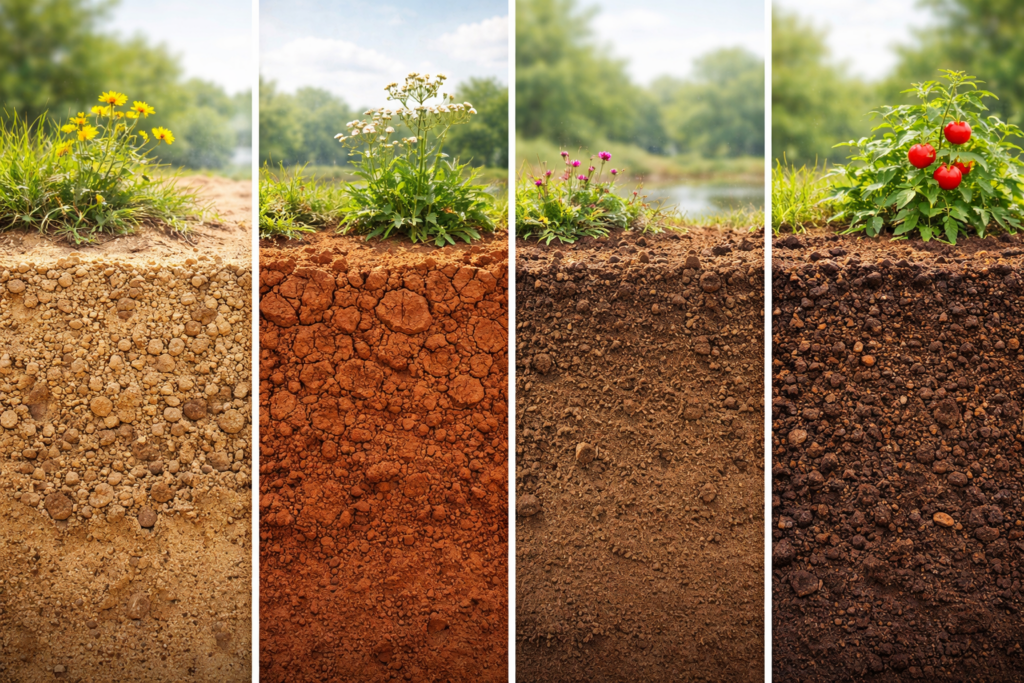
Most basic soil discussions for gardeners include six main soil types:
- sandy soil
- clay soil
- silty soil
- peaty soil
- chalky soil
- loamy soil
These are the true broad soil-type categories. After that, gardeners also use descriptive terms like rich, well-draining, compacted, or poor. Those are useful too, but they are describing soil quality or condition, not the main soil class itself.
Sandy Soil
Sandy soil has larger particles and a loose, gritty feel. Water moves through it quickly, and nutrients can wash out faster than they do in heavier soils.
The good side of sandy soil is that it drains well, warms up quickly in spring, and is usually easy to dig and work. The hard side is that it can dry out fast and may not hold fertility very long unless it is improved with organic matter.
Gardeners with sandy soil often need to water more often, mulch well, and add compost regularly to help the soil hold moisture and nutrients better.
Clay Soil
Clay soil has very fine particles and tends to feel sticky when wet and hard when dry.
It holds water longer than sandy soil and can be very rich in nutrients, but it can also be slow to drain and easy to compact. In some places, clay soil can feel like a brick when dry and like glue when wet.
That makes it one of the more frustrating soils to work with at times.
Still, clay soil is not hopeless. It just needs patience and improvement. Adding compost and organic matter over time can help improve its structure and make it easier to work. The main thing with clay is not to keep fighting it at the wrong moisture level. Wet clay is a mess, and bone-dry clay is miserable.
Silty Soil
Silty soil has smaller particles than sand but not as fine as clay. It often feels smooth, soft, or almost floury when dry and slick when wet.
Silt tends to hold moisture better than sand and is often fairly fertile, which is good. But it can also compact more easily than you might expect, and it may crust over or erode if left bare.
Silty soil can be a good garden soil when managed well, especially if it is protected with mulch and improved with organic matter. It often has a softer, more workable feel than heavy clay but still needs some care.
Peaty Soil
Peaty soil is high in organic matter and often dark in color. It tends to hold moisture well and may feel spongy.
This type of soil forms where organic material breaks down slowly, often in wet conditions. It can be rich in organic content, but it is not always automatically ideal for every crop. Some peaty soils are acidic and may need balancing depending on what you want to grow.
For gardeners, peaty soil can be both a blessing and a challenge. It usually has plenty of organic material, but it may need help with drainage, pH balance, or nutrient management depending on the site.
Chalky Soil
Chalky soil is alkaline and often contains a lot of lime or calcium carbonate. It may be stony and free-draining, but it can also make it harder for plants to take up certain nutrients.
That can lead to plants looking nutrient-deficient even when nutrients are technically present in the soil.
Chalky soil is not something every gardener deals with, but where it exists, it matters. Some plants tolerate it better than others. Organic matter can still help improve structure, but the naturally alkaline character of the soil remains part of the picture.
Loamy Soil
Loam is usually considered the ideal garden soil.
That is because loamy soil contains a balanced mix of sand, silt, and clay, along with a good amount of organic matter. It tends to hold moisture without staying soggy, drain without drying out too fast, and support healthy root growth while still being workable.
When gardeners get dreamy and start talking about beautiful garden soil, loam is usually what they have in mind.
Loamy soil is not perfect in every single situation, but it is the closest thing most gardeners get to a happy medium. It is one of the easiest soils to grow in and one of the most forgiving.
Garden Soil Conditions You Will Also Hear About
Now this is where gardeners sometimes mix up “soil type” with “soil condition” or “soil quality.”
These terms are still important. They just are not the same as the main base soil classes.
Rich Soil
Rich soil usually means the soil contains plenty of organic matter and available nutrients. It often has a darker color and supports strong plant growth.
A soil can be sandy and rich, loamy and rich, or silty and rich. “Rich” is not a separate base type. It is a description of how fertile the soil is.
Well-Draining Soil
Well-draining soil allows extra water to move through without staying waterlogged around the roots.
This is one of the most important qualities in a good garden soil. A soil can hold moisture and still drain well. That is often the sweet spot.
Again, “well-draining” is not a soil type by itself. It is a trait.
Loamy and Rich Soil
This means the soil has the balanced structure of loam and also contains good fertility and organic matter.
That is a wonderful combination for gardening and one of the best things you can have in a home vegetable garden.
Loamy and Well-Draining Soil
This means the soil has the balanced texture of loam and also sheds excess water effectively.
That usually makes it easier to grow a wide range of crops without constant soil drama.
Loamy, Rich, and Well-Draining Soil
This is the dream description.
When gardeners talk about wanting “good garden soil,” this is usually what they mean. Soil like this is balanced, fertile, workable, and kind to plant roots.
It is not a textbook soil class, but it is a very useful description of excellent garden soil.
Compacted Soil
Compacted soil has been pressed down so tightly that roots, water, and air have a harder time moving through it.
This is a condition, not a base type. Clay often compacts more easily, but any soil can become compacted from foot traffic, machinery, or repeated working when wet.
Rocky Soil
Rocky soil contains a lot of stones or gravel. That can make digging harder and limit root development in some crops, especially root vegetables.
Again, this is a condition or characteristic, not one of the main base soil classes.
Poor Soil
Poor soil is just what it sounds like: soil that lacks the structure, fertility, organic matter, drainage balance, or life needed for strong plant growth.
It can be improved, but it often takes time, compost, organic matter, mulch, and patience.
Which Soil Type Is Best for Gardening?
For most garden situations, loamy soil is considered the best.
That is because it offers the best balance of drainage, moisture retention, nutrient holding, and workability. It gives roots room to grow without drying out too fast or staying wet too long.
But most gardeners do not start with perfect loam.
They start with what they have.
And honestly, that is fine. The goal is not to stand in the yard and mourn the soil you do not have. The goal is to understand the soil you do have and improve it over time.
Clay can be improved. Sandy soil can be improved. Silty soil can be improved. Even difficult soils can become much better garden soils with the steady addition of compost and organic matter.
Can You Change Your Soil Type?
You can improve your soil a whole lot, but changing the basic mineral nature of your native soil completely is another matter.
If you have clay soil, you can improve its structure and make it work much better, but your land does not suddenly become naturally sandy loam overnight. If you have sandy soil, you can build it into a richer, more moisture-holding growing medium, but the native character underneath is still part of the story.
That is why most experienced gardeners talk more about improving soil than replacing it.
You work with what you have, build it steadily, and make it better year by year.
That is usually the wisest path.
Final Thoughts
Understanding soil types helps you understand your garden better.
Sandy, clay, silty, peaty, chalky, and loamy soils all behave differently, and each one comes with its own strengths and frustrations. On top of that, gardeners also use practical descriptive terms like rich, well-draining, compacted, or poor to describe how the soil performs.
The more clearly you understand those differences, the better decisions you can make about watering, fertilizing, composting, soil improvement, and crop selection.
Because in the garden, everything starts with the soil.