
The Anatomy of a Plant
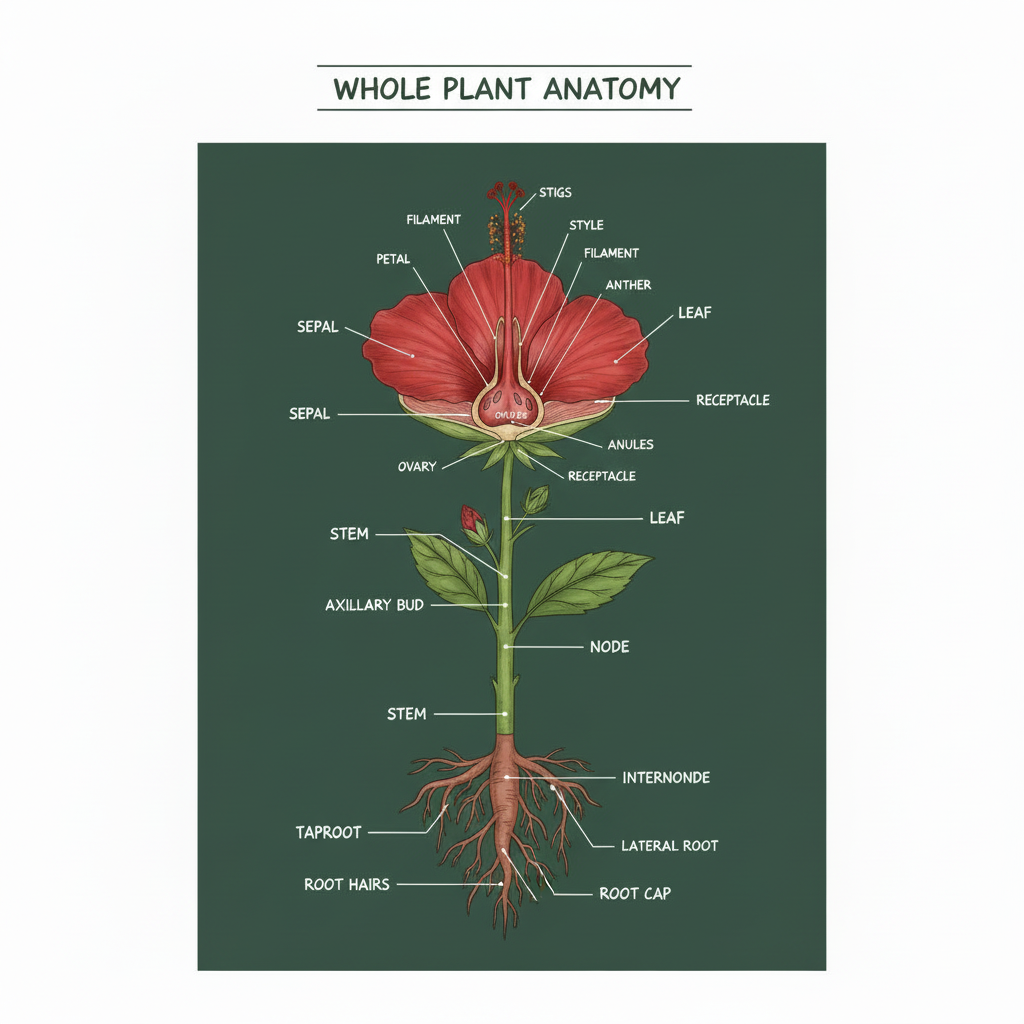
Most people look at a flower and only see the flower itself as a whole. They see the petals and possibly the center of the flower. They see the stem, and the leaves. They note the color of the flower petals. They see the beauty of the flower, but annot see the anatomy of the whole plant.
We look at flowers much the same way as we look at people. We see the overall person, and notice things like eye color, hair color, height and weight…we can’t see the inner workings of a human being, but the anatomy of plants is so much easier to see if you take the time to look.
As people, we have many working parts that not only make us human beings, but also serve to keep us alive and functioning. Look at this chart that compares the parts of a plant, to the parts of a human being:
| Plant Part: | Human Part: |
| Roots – Absorbs nutrients and water from the soil. | Digestive System – Absorbs nutrients from the foods and beverages we ingest. |
| Stems – Provides physical support for the leaves, flowers and fruits, and also transports water and nutrients from the roots to the other parts of the plant. | Arteries: Transfers blood throughout our bodies, carrying vital nutrients and oxygen to our arms, legs, torso, head, and even our hair and toenails. |
| Leaves: This is where most the plants photosynthesis happens. Think of this as a plants form of metabolism, where the nutrients and water the plant is receiving from the roots, through the stem, is converted to energy. | Metabolism: Converts everything we eat and drink to energy, and when we have not fed or watered our bodies, it will use our stores of fat, and then muscle. High metabolism is often believed to be good, but it can be too high. |
| Flowers: This is the reproductive system of the plant. Seeds are produced, which may turn into seedlings eventually. | Reproductive Organs: Those organs required for reproduction of human beings (babies). Semen is often referred to as “seed.” |
So, as you can see, if you think of plants as a a culture of “people” their systems become so much easier to understand. And like people,
Botany is the branch of science that focuses entirely on plants. Scientists in this field look at how plants are built, how they grow, how they make more plants, and how they live in nature.
To understand plants, you have to look at their main parts:
- Roots: These act like anchors to hold the plant in place while soaking up water from the ground.
- Stems: These provide a strong tower to support the plant and act like a highway to move water and food up and down.
- Leaves: These are the plant’s food factories. They use a process called photosynthesis to turn sunlight into the energy the plant needs to stay alive.
Plants are the most important living things on Earth because they give us the oxygen we breathe and the food we eat. Without them, life as we know it wouldn’t exist.
- Copy only the COLUMNS in the Left hand “list view.”
- Paste those into your new page.
- Remove ACF Field in sidebar, replace with ad pattern.
- Move any existing page content into the appropriate column.
- Double check everything.
- Save/Publish