Understanding Photosynthesis
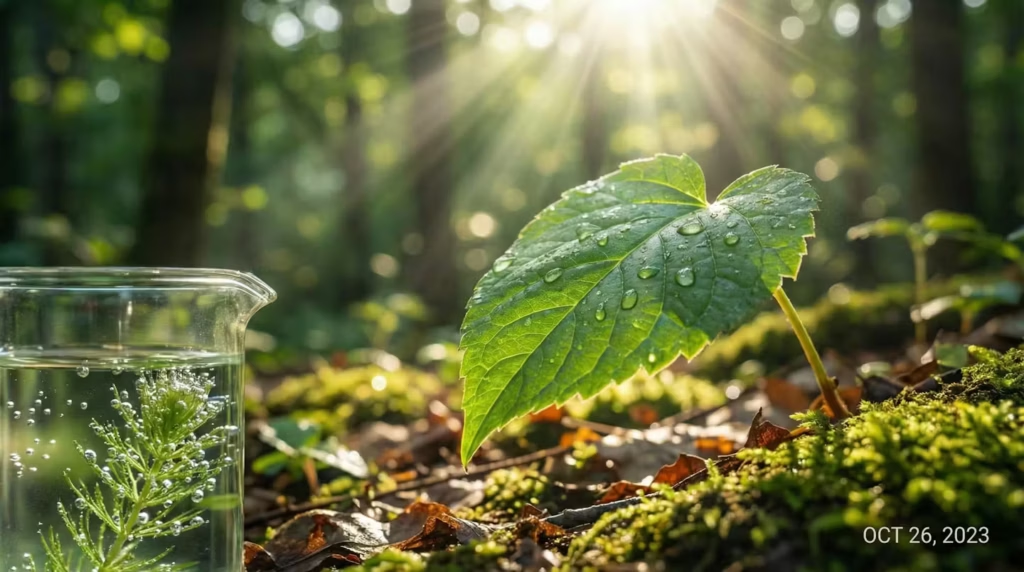
That’s right..we are talking about Photosynthesis because it is important for homesteaders.
Now, don’t you go rolling your eyes at me like I’m back in tenth-grade biology class. I know Photosynthesis sounds like one of those fifty-cent words scientists use to make a simple thing sound complicated, but out here on the farm, it’s the engine under the hood of everything we do.
If you’re gonna call yourself a homesteader, you’d better understand how your plants are cooking up their own dinner, or you’re gonna end up with a garden that looks as sad as a dropped biscuit.
It’s Just Solar-Powered Cooking
Think of a plant leaf like a tiny, green cast-iron skillet. Photosynthesis is just the way a plant takes a little bit of sunshine, a big gulp of air, and a drink of water to whip up its own food. They aren’t like us—they can’t just walk to the pantry when their stomach growls. They’ve gotta make “sugar” (that’s the energy) right there in the leaves.
The “green” you see in your garden? That’s chlorophyll, and it’s basically the solar panel that catches the light. If your plants aren’t getting enough sun, that kitchen is closed, and your veggies are gonna be stunted and spindly, looking for a handout they’re never gonna get.
Why a Homesteader Needs to Care
You might be thinking, “Well, the sun’s been coming up since the dawn of time, why do I need to study it?” Well, sugar, because you’re the manager of this whole operation. When you understand photosynthesis, you stop guessing and start farming.
If you’ve got a row of tomatoes that’s all shade and no fruit, you now know why: they can’t run the stove! You’ll realize that every time you prune a fruit tree or thin out your kale, you’re actually managing “solar real estate.” You’re making sure every leaf has a clear view of the sky so it can keep the factory running.
If you crowd your plants too tight, they’ll start shading each other out, and then nobody’s making enough sugar to grow a decent crop.
Air & Water: The Secret Ingredients
It ain’t just about the light, though. Photosynthesis needs carbon dioxide—that’s the stuff we breathe out—and water from the roots. On a farm, this is why we worry about airflow and soil health. If your garden is packed tighter than a tin of sardines and the air can’t move, your plants are gonna run out of that “air-food.”
And if you let ’em go bone-dry in a July heatwave? That plant is gonna shut its “pores” (we call ’em stomata, but let’s not get fancy) to save water. When those pores close, the plant stops taking in air, which means the cooking stops. A thirsty plant is a starving plant, even if the sun is shining bright enough to melt your flip-flops.
The Midnight Shift
Here’s the part most folks forget: the plant spends all day making that sugar, but it spends the night using it to actually build roots, stems, and fruit. We call that respiration. If the nights stay too hot—like they do during those muggy Texas summers—the plant burns through its food faster than it can make it.
That’s why your tomatoes might stop growing when the low temperature is still 85 degrees at midnight. They’re basically working overtime just to stay alive and don’t have anything left over to make a big, juicy fruit for your sandwich. Understanding this helps you keep your cool when the garden stalls out; it ain’t your fault, the “kitchen” is just overheated.
Managing the Factory Floor
When you get a handle on photosynthesis, you start looking at your homestead differently. You’ll see a weed not just as a nuisance, but as a thief stealing the light and water your “workers” need. You’ll see a mulch bed not just as a decoration, but as a way to keep the water steady so the stove stays on.
At the end of the day, we’re just sun-farmers. We’re capturing the energy of the heavens and turning it into something we can fry up in a pan. Once you respect the science behind that green leaf, you’ll be a whole lot better at keeping it healthy.