What Do You Eat?
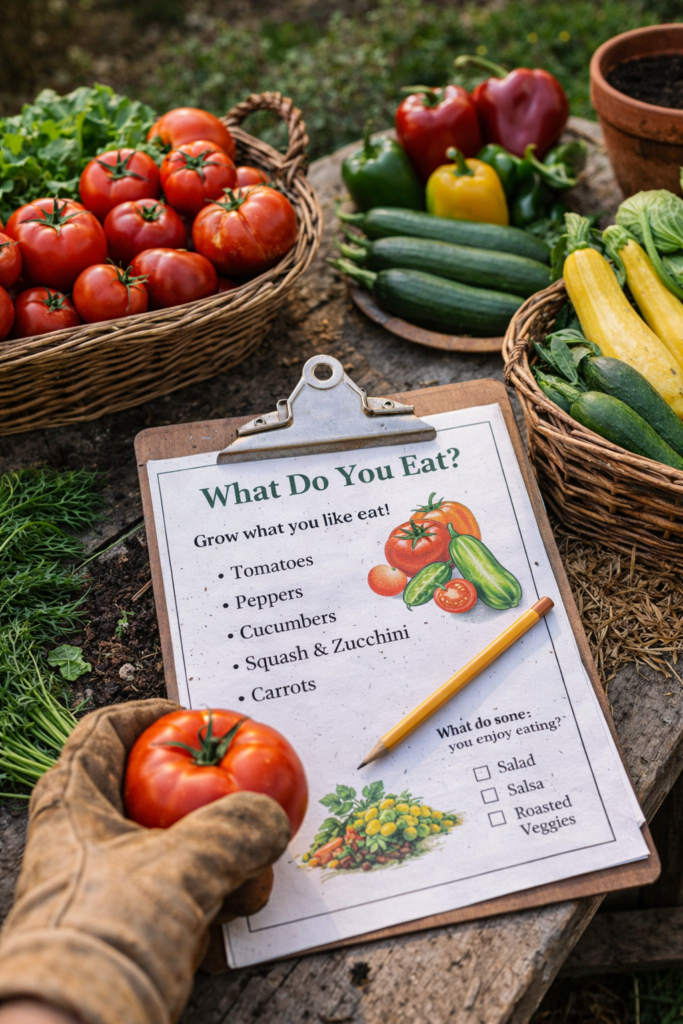
This may be the most practical gardening question of all, and somehow it gets skipped all the time.
Before you start buying seeds, drawing bed maps, planning harvests, and daydreaming about a garden so full it looks like a magazine spread, stop and ask one simple question:
What do you actually eat?
-Not what sounds impressive.
-Not what everybody else grows.
-Not what looked pretty in the seed catalog.
-Not what some stranger on the internet said every garden “must” have.
What do you eat?
Because if you are going to spend time, money, water, and effort growing food, it makes sense to grow food that has a real place in your kitchen.
The Garden Should Fit the Table
A lot of people plan a garden from the outside in. They think first about popular crops, common advice, or what feels like a “proper” garden. That is how you wind up with zucchini nobody wants, radishes nobody touches, and enough cucumbers to start a neighborhood crisis.
A smarter way is to plan from the table backward.
Look at the meals you actually cook. Look at what gets eaten fresh, what gets used in recipes, what gets preserved, what gets packed in lunches, and what disappears quickly from the kitchen. That tells you far more about what belongs in your garden than a generic planting list ever will.
A useful garden is not the one that grows the most things. It is the one that grows the right things.
Start With Your Real Food Habits
This is where honesty helps.
Think about the foods your household really uses. Not once in a while. Not “in theory.” Not “if I were a different person with a different life.” Think about what actually gets eaten in your home on a regular basis.
Ask yourself things like:
- Which vegetables do we buy over and over?
- Which herbs do I reach for all the time?
- What produce gets used fresh every week?
- What do we snack on?
- What do I preserve, freeze, dry, or can?
- What do I cook most often?
Those answers matter.
If your family eats tomatoes constantly, then tomatoes deserve a major place in the plan. If nobody likes beets, there is no reason to grow beets just because they sound wholesome and old-fashioned. If fresh herbs make a real difference in your cooking, then herbs may deserve more space than yet another vegetable you feel morally obligated to plant.
Fresh Eating and Preservation Are Not the Same Thing
This is another place where garden planning goes sideways.
A crop you want for fresh eating is not planned the same way as a crop you want to preserve. A few tomato plants may be plenty for slicing and salads, but not nearly enough if you want to can sauce, make salsa, and still eat them fresh all season. The same goes for peppers, green beans, onions, herbs, and just about everything else.
So it helps to ask:
- Do I want this for fresh use only?
- Do I want enough to preserve too?
- Do I want just a taste of it, or a real supply?
That changes how much you grow.
A garden planned around fresh summer meals looks different from one planned around stocking the pantry and freezer.
Grow the Expensive Stuff First
One very practical strategy is to start with what you use often and what costs more at the store.
Fresh herbs are a perfect example. A small amount at the grocery store can be surprisingly expensive, while a healthy herb plant can give and give for months. Salad greens can also be worth growing if you eat them regularly, especially if you like fresh mixed greens. Tomatoes, specialty peppers, cucumbers, and other favorites often make sense here too.
The point is not to treat the garden like a spreadsheet. The point is to notice where growing your own actually gives you useful value.
If you never buy eggplant, growing eggplant may not be your smartest first move. If you buy basil, parsley, tomatoes, and peppers constantly, that tells you something.
Be Careful With “Aspirational Gardening”
This is where gardeners get themselves in trouble.
Aspirational gardening is when you plant for the person you imagine yourself becoming instead of the person who actually lives in your house and cooks in your kitchen. Suddenly you are growing kale because you feel like you ought to be a kale person, or planting ten kinds of greens because that sounds virtuous, while the household keeps reaching for potatoes, onions, tomatoes, and herbs.
There is nothing wrong with experimenting. Every garden should have some room for trying new things. But the backbone of the garden should be built around real use, not fantasy identity.
If you build the whole garden around aspiration, the harvest can start feeling like guilt.
Think in Categories
Sometimes it helps to think in food-use categories instead of individual crops at first.
For example:
- salad vegetables
- cooking vegetables
- soup and stew vegetables
- snacking vegetables
- herbs
- canning crops
- freezing crops
- drying crops
- fruits for fresh eating
- fruits for jam or jelly
That approach can make the planning feel more natural. You are not just asking whether to grow carrots. You are asking whether your household uses root vegetables often, whether you preserve them, and whether they truly earn their space in the garden.
That gives you a more functional garden plan.
Quantity Matters Too
It is not enough to know what you eat. You also need to know how much you eat.
If your family likes green beans once in a while, that is one thing. If you eat them constantly and freeze them by the gallon, that is another. If you use one rosemary sprig now and then, one plant may be more than enough. If you cook with basil every other day and make pesto too, that is a different story entirely.
This is where some observation helps. Pay attention to your kitchen for a few weeks. Notice what gets used up, what gets bought repeatedly, and what would genuinely be helpful to have growing outside or on the deck.
Your grocery habits can tell you a lot about your garden priorities.
Leave Room for Pleasure
Now, a garden does not have to be purely practical to deserve space.
You are allowed to grow things because they are beautiful, fun, nostalgic, or interesting. You are allowed to try something just because you want to. You are allowed to plant one ridiculous thing every season for no reason other than delight.
That is not wasteful. That is part of the joy of gardening.
The point is simply not to let those fun extras crowd out the crops that actually serve your kitchen and your table. A wise garden usually has both:
- useful staples
- a little room for joy
That is a much healthier balance than either grim utility or total chaos.
The Best Garden Is the One You Use
At the end of the day, the most successful garden is not the one that impresses people most. It is the one that gets harvested, cooked, enjoyed, preserved, and appreciated.
If your garden gives you food you really use, then it is doing its job. If it is full of things nobody wants, then even a beautiful harvest can start feeling like work instead of blessing.
So when you plan the garden, start with the kitchen. Start with the meals. Start with the people eating the food.
That is where a useful garden begins.
Final Thoughts
Before you decide what to grow, ask what you actually eat. Look at your meals, your grocery habits, your favorite foods, and the crops that truly earn their place in your kitchen. Plan for fresh use, preservation, and the real quantity your household will use, not just what sounds good on paper.
Because the best garden is not the one that grows the most things. It is the one that grows the things you are genuinely glad to have.