Growing Food on the Homestead
A productive homestead needs more than a house, a water source, and a good attitude. At some point, the land itself has to start helping feed the people who live on it. That does not mean every homestead needs a huge garden, a commercial orchard, or enough food to feed the whole county. It means you need a practical plan for growing food that fits your space, your climate, your time, your strength, and the way your family actually eats.
For a new homesteader, food growing can feel exciting and overwhelming at the same time. Seed catalogs make everything look possible. Fruit trees sound romantic. Berry bushes sound easy. A big vegetable garden sounds like the answer to every grocery bill problem. But the truth is, gardens and fruit trees are infrastructure. They take planning, placement, maintenance, water, soil improvement, protection, and time.
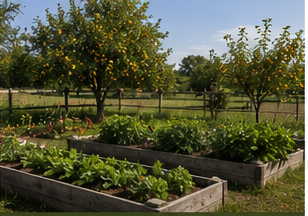
A garden is not just a place where vegetables grow. It is a food-production system. Fruit trees are not just pretty trees that might give you peaches someday. They are long-term food investments. Perennial plants, berries, herbs, vines, and nut trees can become part of a permanent food system that gets stronger with each passing year.
The goal is not to plant everything at once. The goal is to build a food-growing system you can actually maintain.
Start With What You Eat
Before you plant anything, look at your kitchen. A homestead garden should begin with your real meals, not with someone else’s dream garden.
If your family eats green beans, tomatoes, onions, potatoes, peppers, squash, cucumbers, herbs, and fruit, those are strong starting points. If nobody in the house eats eggplant, you do not need six eggplant plants just because they looked beautiful at the garden center.
The same rule applies to fruit trees. If your household eats peaches, plums, figs, apples, pears, persimmons, grapes, blackberries, and strawberries, those crops make sense. If nobody likes a certain fruit, it may not deserve space, water, pruning time, and years of waiting.
Food-growing infrastructure should support the pantry, the freezer, the canning shelves, and the dinner table. It should not create extra work for crops nobody wants to eat.
Build the Garden Before You Fill It
A productive garden starts with structure. This may include raised beds, in-ground rows, fenced areas, trellises, paths, compost areas, irrigation, tool storage, and a place to start or harden off seedlings.
New homesteaders often rush into planting before the garden is ready. Then the season turns into dragging hoses, fighting weeds, stepping over mud, losing tools, and wondering why everything feels harder than it should.
Good garden infrastructure answers basic questions:
- Where will the beds go?
- How will water reach them?
- How will you move through the garden?
- Where will trellises go?
- How will you keep animals out?
- Where will compost and mulch be stored?
- Where will harvest baskets, hand tools, row covers, and stakes live?
A garden that is easy to reach and easy to water will be used more often. A garden that is awkward, too far away, too exposed, or too hard to maintain will become a burden.
This does not mean the garden has to be fancy. It means it needs to be workable.
Plan for Water From the Beginning
Gardens and young fruit trees need dependable water. If water is hard to access, the garden will suffer, especially in hot weather.
Before expanding the garden, think through hoses, drip irrigation, timers, rainwater collection, mulch, and how much watering you can realistically keep up with. A small, well-watered garden can produce more useful food than a large garden that dries out every week.
Fruit trees also need careful watering during establishment. A newly planted tree cannot be treated like a wild tree that has been growing for twenty years. Young trees need deep watering, mulch, and protection from stress while they build roots.
Water planning is not separate from food planning. It is part of it.
Improve the Soil Every Year
The soil is one of the most important pieces of homestead infrastructure. Poor soil can make gardening feel like a constant battle. Good soil makes everything easier.
Soil improvement does not happen all at once. It is built over time with compost, mulch, cover crops, leaf mold, aged manure when appropriate, and careful feeding. Every season should leave the soil better than it was before.
Raised beds may need to be filled and refreshed. In-ground gardens may need organic matter worked in or layered on top. Fruit trees benefit from mulch rings and soil life around their root zones. Berries and perennial plants need steady fertility without being smothered or overfed.
A good homestead garden is not just planted every year. It is fed every year.
Add Fruit Trees Early, But Thoughtfully
Fruit trees take time. That is why they should be considered early in the homestead plan. A tomato can produce in one season. A peach, apple, pear, plum, persimmon, or pecan may take years before it gives a meaningful harvest.
That does not mean planting fruit trees should be rushed. Trees are harder to move than vegetable beds. Their placement matters.
Before planting fruit trees, consider:
- Sun exposure
- Mature size
- Spacing
- Drainage
- Chill hour needs
- Pollination requirements
- Disease pressure in your area
- Harvest season
- Access for pruning and picking
- Distance from buildings, fences, driveways, and power lines
A fruit tree planted in the wrong place can become a long-term problem. A fruit tree planted in the right place can feed a family for years.
It is usually better to plant fewer trees well than to plant too many trees in a hurry.
Think Beyond Annual Vegetables
Annual vegetables are important, but they are only one part of a homestead food system. Perennial food plants can reduce workload over time and provide harvests year after year.
Perennial food systems may include fruit trees, berry bushes, grapevines, asparagus, rhubarb, artichokes in suitable climates, perennial herbs, nut trees, edible flowers, and medicinal plants.
These plants help create a more permanent food landscape. Once established, many perennials need less yearly planting than annual crops. They still require care, but they do not have to be restarted from seed every spring.
A strong homestead food system usually includes both annual and perennial crops. Annuals give flexibility and fast harvests. Perennials build long-term abundance.
Protect the Food You Grow
If you grow food, something else will want to eat it. Deer, rabbits, raccoons, birds, squirrels, insects, chickens, goats, dogs, and even the family cat can become part of the food-growing problem.
Protection should be included in the infrastructure plan. Depending on the homestead, that may mean fencing, netting, row covers, cages, tree guards, hardware cloth, electric fencing, or designated animal-free growing areas.
Young fruit trees often need trunk protection. Berries may need bird netting. Vegetable gardens may need fencing before the first seed is planted. If chickens free-range, they may need to be kept out of young beds and mulch areas.
Food protection is not a sign that gardening has gone wrong. It is part of homestead reality.
Grow in Stages
The biggest mistake many new homesteaders make is trying to build the entire food system in one season.
A better plan is to grow in stages.
The first stage might be a small kitchen garden with the most-used vegetables and herbs. The second stage might add more beds, trellises, composting, and better irrigation. The third stage might add fruit trees, berries, grapes, and perennial herbs. Later stages can include larger orchards, food forests, seed-saving areas, greenhouse space, or market-growing sections if desired.
Every new section should earn its place. If a garden bed is hard to maintain, fix the system before adding more. If fruit trees are struggling, solve the water, mulch, pruning, or soil issue before planting a dozen more.
Homesteading rewards steady building, not frantic expansion.
Match the System to Your Life
A food-growing system has to match the people who are actually caring for it. A young, strong family with several adults available can handle a different system than one person caring for children, elders, animals, health issues, or a full-time job.
There is no shame in choosing raised beds because they are easier to manage. There is no shame in planting dwarf or semi-dwarf fruit trees instead of full-size trees. There is no shame in starting with containers, herbs, berries, or a small fenced garden.
The right garden is the one you can tend consistently.
A neglected acre will not feed you as well as a well-managed set of beds. A huge orchard full of unpruned, diseased trees is not better than six healthy trees that are watered, mulched, and harvested.
Homestead food systems should create security, not constant overwhelm.
A Garden Is Infrastructure
It is easy to think of infrastructure as wells, barns, fences, roads, and power systems. But the garden belongs on that list too.
A well-planned garden supports the kitchen. Fruit trees support long-term food security. Perennial crops support future harvests. Compost supports the soil. Irrigation supports production. Fencing supports protection. Paths support access. Trellises support vertical growing. Storage areas support tools and harvests.
All of these pieces work together.
The garden is not just a seasonal hobby tucked behind the house. On a working homestead, it becomes part of the household food system. It deserves the same practical planning as water, shelter, fencing, and tools.
Start with what you eat. Build only what you can maintain. Improve the soil every year. Plant fruit trees with care. Add perennials steadily. Protect what you grow. Keep expanding only as your systems can support it.
A homestead does not become food secure in one season. It becomes food secure one bed, one tree, one harvest, and one good decision at a time.